 ICE Spotted
ICE Activity in California 2026: Community Reports and Enforcement Hotspots
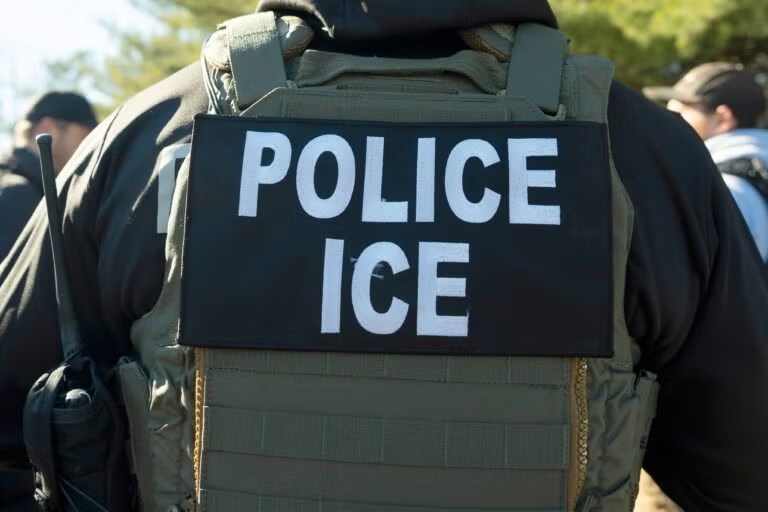
California has long been at the center of the national debate over immigration enforcement. As the state with the largest immigrant population in the United States — an estimated 10.5 million foreign-born residents — it is also the state where federal Immigration and Customs Enforcement (ICE) operations have the broadest impact. In 2026, community reports submitted through platforms like ICE Spotted reveal a sharp escalation in enforcement activity across multiple regions of the state, from the densely populated neighborhoods of Los Angeles to agricultural communities in the Central Valley and border-adjacent areas near San Diego.
This article provides a region-by-region breakdown of where ICE operations are being reported in California, the types of enforcement actions communities are witnessing, how the state's sanctuary policies are interacting with federal agents, and what resources are available if you or someone you know encounters ICE in California.
Los Angeles and Southern California: The Highest Concentration of Reports
Los Angeles County consistently generates the highest volume of ICE sighting reports in California. Community members have submitted reports from neighborhoods across the county, with particular concentrations in areas including Koreatown, Boyle Heights, Pico-Union, South Los Angeles, and the San Fernando Valley. The types of operations reported range from early-morning residential raids to agents stationed near public transit stops, day labor gathering sites, and courthouse entrances.
In January and February 2026, ICE Spotted received multiple reports of unmarked vans operating in coordinated groups of three to five vehicles in East Los Angeles and Compton. Witnesses described agents wearing tactical vests marked "POLICE" and face coverings, arriving at residential addresses between 4:00 AM and 6:00 AM. Several reports noted that agents were accompanied by local law enforcement officers, despite Los Angeles being a sanctuary city with policies that generally prohibit local police from cooperating with federal immigration enforcement.
Sanctuary City Note: The City of Los Angeles has a Special Order 40 policy that restricts LAPD officers from initiating contact solely to determine immigration status. However, federal agents can and do operate independently within city limits, and some operations have involved task forces that include local officers in a non-immigration capacity.
Read the Los Angeles local guide for a tighter neighborhood-level breakdown of Boyle Heights, Pico-Union, Koreatown, South LA, and county transit / day-labor patterns.
Read the Inland Empire local guide for a narrower page focused on warehouse corridors, freeway on-ramps, bus stations, and worksite enforcement in Santa Ana, Anaheim, Ontario, Riverside, and San Bernardino.
Orange County, Riverside County, and San Bernardino County — collectively known as the Inland Empire — have also seen a notable uptick in reported ICE activity. Community reports from cities like Santa Ana, Anaheim, Ontario, and San Bernardino describe checkpoint-style operations near freeway on-ramps and bus stations, as well as targeted enforcement at workplaces in the construction and warehousing industries.
San Francisco Bay Area: Enforcement Despite Strong Sanctuary Protections
The San Francisco Bay Area maintains some of the strongest sanctuary protections in the country. San Francisco's sanctuary ordinance, first adopted in 1989 and strengthened multiple times since, prohibits city employees from assisting with federal immigration enforcement. Oakland, Berkeley, and San Jose have similar policies. Despite these protections, ICE operations continue throughout the region.
Community reports from early 2026 describe ICE agents conducting surveillance outside immigration courts in San Francisco and conducting targeted arrests at residential addresses in Oakland's Fruitvale district, a predominantly Latino neighborhood. In the South Bay, reports from San Jose and Gilroy indicate agents have been seen near agricultural worker housing and at Caltrain stations.
One pattern that Bay Area community members have flagged repeatedly is the use of plainclothes agents in areas near immigration legal service offices. Multiple reports describe individuals in civilian clothing with concealed badges waiting in parked vehicles outside attorneys' offices or nonprofit legal clinics. When sanctuary policies prevent local police from notifying ICE about individuals in custody, federal agents have adapted by increasing their presence in public spaces where they know undocumented individuals are likely to appear.
Read the Bay Area local guide for a narrower page focused on immigration-court zones, Fruitvale residential reporting, South Bay transit movement, and legal-services corridor surveillance.
Central Valley: Agricultural Communities Under Pressure
California's Central Valley — stretching from Sacramento through Stockton, Modesto, Fresno, and down to Bakersfield — is home to one of the largest agricultural workforces in the world. The region's economy depends heavily on immigrant labor, and it is also an area where ICE enforcement has historically been aggressive.
In 2026, community reports from the Central Valley describe a range of enforcement activity. In Fresno County, multiple reports indicate ICE agents have been conducting operations near agricultural labor camps and in the parking lots of grocery stores and laundromats in towns like Selma, Parlier, and Orange Cove. In Kern County, reports from Bakersfield and Delano describe agents stationed at Greyhound bus stations and near health clinics.
Community Alert: Central Valley community organizations report that ICE agents have been approaching individuals outside health clinics and food distribution sites. If you witness this activity, document the time, location, and number of agents, and submit a report through ICE Spotted. Federal policy prohibits enforcement actions at sensitive locations, and documentation of these incidents is critical.
Read the Central Valley local guide for a narrower page focused on Fresno labor-camp zones, Kern County clinic and bus-station patterns, and Stockton / Modesto surveillance reports.
Stockton and Modesto have also generated a steady stream of reports. Community members describe unmarked SUVs conducting slow patrols through residential neighborhoods with high concentrations of immigrant families. In several instances, agents were reportedly seen photographing homes and license plates before departing without making any arrests, suggesting these were surveillance operations in preparation for future enforcement actions.
San Diego and the Border Region
Given its proximity to the U.S.-Mexico border, San Diego County has always had a significant federal law enforcement presence. However, community reports from 2026 indicate that interior enforcement — operations conducted away from the immediate border zone — has increased substantially. Reports from neighborhoods like Barrio Logan, City Heights, San Ysidro, and National City describe frequent ICE vehicle sightings and targeted arrests.
One distinguishing characteristic of ICE operations in the San Diego region is the close coordination between ICE ERO teams, Customs and Border Protection (CBP), and the Border Patrol. Community members report seeing mixed-agency operations where agents from multiple federal agencies work together. Vehicles from different agencies — some marked, some not — have been observed arriving at the same location simultaneously.
The checkpoint on Interstate 5 near San Clemente, operated by Border Patrol approximately 60 miles north of the border, remains one of the most reported enforcement points in the state. While this is a permanent Border Patrol checkpoint rather than an ICE operation, community members frequently confuse the two. Reports also indicate that ICE agents have been present at or near this checkpoint conducting targeted enforcement of individuals identified during checkpoint screenings.
Read the San Diego local guide for a narrower page focused on interior enforcement, mixed-agency border-region operations, and checkpoint-adjacent reporting context.
California's Sanctuary State Law: SB 54 and Federal Pushback
California's sanctuary state law, SB 54 (the California Values Act), limits how state and local law enforcement agencies can cooperate with federal immigration authorities. Under SB 54, local jails and police departments are generally prohibited from honoring ICE detainer requests, notifying ICE of a detained person's release date, or providing ICE agents with access to individuals in local custody — with certain exceptions for individuals convicted of serious or violent felonies.
In 2026, the tension between SB 54 and federal enforcement priorities has intensified. The federal government has publicly criticized California's sanctuary policies and has taken steps to increase the number of ICE agents stationed in the state. Community reports reflect this escalation: more agents are operating in the field, and operations appear to be more frequent and more widespread than in previous years.
It is important for California residents to understand that while SB 54 limits local police cooperation with ICE, it does not prevent federal agents from operating independently within the state. ICE agents have full legal authority to conduct enforcement operations anywhere in California, and they do not need the permission or assistance of local law enforcement to do so.
How to Report ICE Sightings in California
If you witness ICE enforcement activity anywhere in California, submitting a timely report helps your community stay informed. When documenting a sighting, include as much detail as possible:
- Location: City, cross streets, or nearby landmarks. The more specific, the better.
- Time: When you observed the activity, including whether agents appeared to be arriving, actively conducting an operation, or departing.
- Vehicles: Number, type (van, SUV, sedan), color, and whether they had government plates or visible markings.
- Agents: Number of agents visible, what they were wearing (tactical gear, plainclothes, vests with markings), and what they appeared to be doing.
- Other agencies: Whether local police or other federal agencies appeared to be involved.
You can submit a report using the anonymous form below or through the ICE Spotted homepage. All reports are anonymous — no IP address, name, or identifying information is collected.
Legal Resources for California Residents
California offers more legal resources for immigrants facing enforcement actions than almost any other state. Key resources include:
- California Immigration Legal Services Directory: The California Department of Social Services maintains a directory of free and low-cost immigration legal service providers organized by county.
- Rapid Response Networks: Many California cities have community-based rapid response networks that deploy trained observers when ICE activity is reported. These networks exist in Los Angeles, San Francisco, Oakland, San Jose, Sacramento, and several Central Valley communities.
- Know Your Rights Hotlines: Organizations like the ACLU of California, the National Immigration Law Center, and local legal aid societies operate hotlines that provide immediate guidance if you encounter ICE agents.
- California Attorney General's Office: The state attorney general has published guidance on immigrant rights under California law, including a Know Your Rights card available in multiple languages.
Remember: Regardless of your immigration status, you have constitutional rights. You have the right to remain silent, the right to refuse consent to a search, and the right to ask whether agents have a judicial warrant signed by a judge. You are not required to open your door to ICE agents unless they present a warrant signed by a federal judge.
ICE Activity Map: Real-Time Reports
The map below shows recent community-reported ICE activity across the United States, with a concentration of reports from California. Red markers indicate reported sightings, checkpoints, and enforcement operations.