 ICE Spotted
ICE Activity in Arizona 2026: Community Reports and Enforcement Hotspots
Arizona occupies a unique and volatile position in the landscape of U.S. immigration enforcement. Sharing a 370-mile border with Mexico, the state has been a primary corridor for both migration and federal enforcement operations for decades. In 2026, community reports submitted through ICE Spotted and partner organizations reveal that enforcement activity across Arizona has reached levels not seen since the height of the SB 1070 era. From the sprawling suburbs of the Phoenix metropolitan area to the desert corridors south of Tucson, ICE agents are conducting operations with increasing frequency, scope, and visibility.
This article provides a detailed breakdown of where ICE enforcement is being reported across Arizona, the specific tactics communities are witnessing, the state's legal and political context that shapes enforcement, and what resources are available if you or someone you know encounters ICE in the Grand Canyon State.
Phoenix Metro Area: Maryvale, South Phoenix, and the East Valley
The Phoenix metropolitan area is home to the largest concentration of ICE enforcement reports in Arizona. With a population of nearly five million people and one of the fastest-growing immigrant communities in the Southwest, the metro area has become a focal point for federal operations in 2026. Community reports submitted to ICE Spotted describe a wide range of enforcement actions across the region, with particular intensity in neighborhoods that have historically large Latino populations.
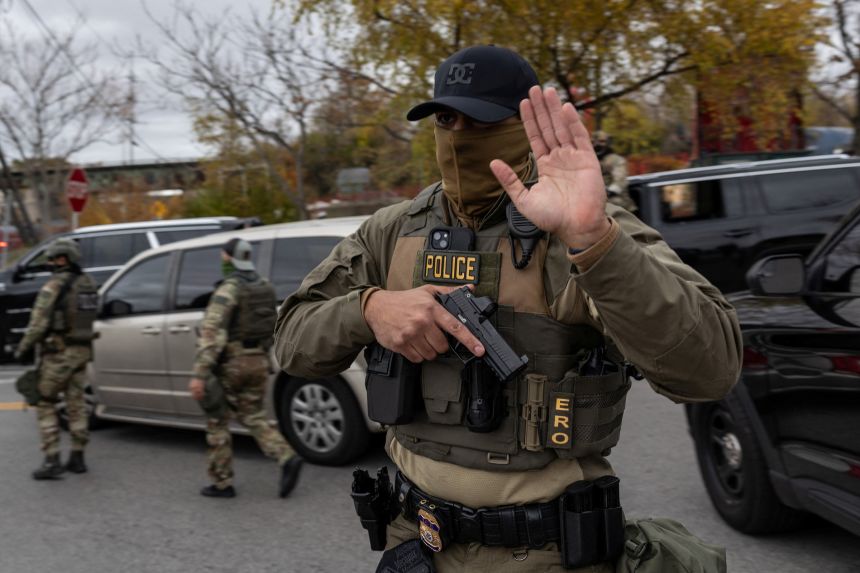
Maryvale, a predominantly Hispanic community in west Phoenix, has generated the highest volume of sighting reports. Community members describe ICE vehicles — both marked and unmarked — conducting slow patrols along residential streets, particularly during early morning hours between 4:00 AM and 7:00 AM. Multiple reports describe coordinated operations involving three to six vehicles converging on a single residential address, with agents in tactical vests and face coverings approaching homes before sunrise. Witnesses have noted that some agents carry long rifles during these operations, a tactic that community advocates say is designed to intimidate residents into compliance.
South Phoenix, another area with a large immigrant population, has seen similar patterns. Reports describe agents stationed near day labor gathering points along major intersections, particularly near 24th Street and Baseline Road, and along the 35th Avenue corridor. In several instances, community members reported that agents approached individuals waiting for work, asked for identification, and detained those who could not produce documents. These operations at day labor sites have drawn sharp criticism from community organizations, who argue that they target workers engaged in lawful activity in public spaces.
Day Labor Site Alert: Multiple community reports from January and February 2026 describe ICE agents approaching day laborers at gathering points in Maryvale, South Phoenix, and Mesa. If you witness enforcement activity near day labor sites, document the time, exact location, number of agents, and vehicle descriptions, and submit a report through ICE Spotted. Advocacy organizations are tracking these incidents to determine whether they constitute a pattern.
The East Valley — encompassing Mesa, Chandler, Gilbert, and Tempe — has also emerged as an active enforcement zone. Mesa, the third-largest city in Arizona, has reported a surge in ICE activity near its downtown corridor and in neighborhoods along Main Street and Broadway Road. Chandler has seen agents conducting what appear to be workplace operations at construction sites and landscaping companies, arriving in unmarked vans during midday hours and detaining workers on-site. Community members in Gilbert have reported seeing ICE vehicles near shopping centers that serve predominantly immigrant clientele, including tiendas and money transfer businesses.
Tucson and the Southern Border Corridor
Tucson's proximity to the U.S.-Mexico border — just 60 miles north of Nogales — makes it a perpetual hotspot for immigration enforcement. In 2026, community reports from the Tucson area describe a complex web of enforcement activity involving ICE ERO agents, Customs and Border Protection officers, and Border Patrol units, often operating in overlapping jurisdictions and sometimes in coordinated joint operations.
The Interstate 19 corridor between Tucson and Nogales remains one of the most heavily reported enforcement zones in the state. Community members regularly report checkpoint activity along this stretch of highway, with both fixed and roving checkpoints that screen vehicles heading northbound. While the permanent checkpoint near Tubac is operated by Border Patrol, community reports indicate that ICE agents have been observed stationed at or near these checkpoints, apparently conducting targeted enforcement of individuals flagged during screening.
I-19 Corridor Warning: Community reports from early 2026 indicate increased checkpoint activity along I-19 between Tucson and Nogales. Reports describe roving checkpoints appearing at irregular intervals in addition to the permanent checkpoint near Tubac. If you are traveling along this corridor, be aware that you may be stopped and questioned. You have the right to remain silent and to decline a vehicle search absent a warrant.
Within the city of Tucson itself, community reports describe ICE agents operating near the Southside neighborhood, in the area around South 6th Avenue and 29th Street, and near public transit stops along the Sun Link streetcar route. Humanitarian organizations operating in the Tucson area, including No More Deaths/No Mas Muertes, have reported an increase in federal agents surveilling their operations, particularly water drop stations in the desert south and west of the city. These groups provide life-saving aid to migrants crossing through remote desert areas, and the increased surveillance has raised concerns about the federal government targeting humanitarian workers.
Maricopa County: The Legacy of SB 1070 and 287(g)
Maricopa County, which encompasses the entire Phoenix metro area, has a long and contentious history with immigration enforcement. For nearly two decades under former Sheriff Joe Arpaio, the Maricopa County Sheriff's Office conducted aggressive immigration sweeps through its participation in the federal 287(g) program, which deputizes local law enforcement to perform certain immigration enforcement functions. Although Arpaio was voted out of office in 2016 and the department's 287(g) agreement was eventually modified, the program's legacy continues to shape the enforcement landscape.
In 2026, Maricopa County continues to participate in the 287(g) program under a modified agreement. Under this arrangement, trained jail officers screen individuals booked into county jails and notify ICE of those identified as potentially removable noncitizens. Community advocates argue that this practice effectively turns every arrest — including arrests for minor offenses like traffic violations — into an immigration enforcement event, discouraging immigrant community members from interacting with law enforcement even when they are victims of crime.
Reports from community members describe a pattern of close coordination between ICE and local law enforcement in Maricopa County that goes beyond the formal 287(g) agreement. Multiple reports describe local police officers conducting what appear to be pretextual traffic stops — pulling over vehicles for minor violations like cracked windshields or missing license plate lights — and then calling ICE agents to the scene. In some cases, community members report that ICE agents arrived within minutes of a traffic stop, suggesting that agents were already in the area and in communication with local officers.
Arizona's Legal Context: SB 1070, Pro-Enforcement Policy, and No Sanctuary Protections
Arizona's legal and political environment is among the most favorable to aggressive immigration enforcement of any state in the country. The state gained national attention in 2010 with the passage of SB 1070, the "Support Our Law Enforcement and Safe Neighborhoods Act," which attempted to make it a state crime to be an undocumented immigrant and required local police to check the immigration status of anyone they stopped if they had "reasonable suspicion" the person was in the country illegally. While the U.S. Supreme Court struck down several provisions of SB 1070 in 2012, it upheld the "show me your papers" provision requiring status checks during lawful stops.
Unlike states such as California, Illinois, or Colorado, Arizona has no sanctuary protections at the state level. There is no state law prohibiting local law enforcement from cooperating with ICE, honoring immigration detainers, or sharing information about individuals in custody. In fact, Arizona law generally moves in the opposite direction: state statutes require cooperation with federal immigration authorities, and the state legislature has repeatedly passed measures designed to prevent any city or county from adopting sanctuary-style policies.
Legal Note: Arizona law prohibits cities and counties from adopting policies that limit cooperation with federal immigration enforcement. This means that unlike in sanctuary states, local police in Arizona can and often do cooperate directly with ICE, including honoring detainer requests, sharing information about individuals in custody, and facilitating arrests at county jail facilities.
This legal environment means that immigrants in Arizona face enforcement risks from both federal agents and local law enforcement. The absence of sanctuary protections removes a layer of separation between local police encounters and immigration consequences that exists in other states. For community members in Arizona, any interaction with law enforcement — even a routine traffic stop — carries the potential for immigration enforcement consequences.
How to Report ICE Sightings in Arizona
If you witness ICE enforcement activity anywhere in Arizona, submitting a timely and detailed report helps your community stay informed and helps advocacy organizations track enforcement patterns. When documenting a sighting, include as much of the following information as possible:
- Location: City, cross streets, or nearby landmarks. Specify the neighborhood if in the Phoenix or Tucson metro areas.
- Time: When you observed the activity, including whether agents appeared to be setting up, actively conducting an operation, or departing.
- Vehicles: Number, type (van, SUV, sedan), color, and whether they had government plates, visible markings, or were unmarked.
- Agents: Number of agents visible, attire (tactical gear, plainclothes, vests with "POLICE" or "ICE" markings), and whether they were armed with visible weapons.
- Local law enforcement: Whether local police, sheriff's deputies, or other agencies appeared to be involved or present at the scene.
You can submit a report using the anonymous form below or through the ICE Spotted homepage. All reports are anonymous — no IP address, name, or identifying information is collected or stored.
Legal Resources for Arizona Residents
Although Arizona's legal environment is less protective of immigrants than many other states, several organizations provide critical legal assistance and community support:
- Florence Immigrant & Refugee Rights Project: Based in Florence, Arizona, this organization provides free legal services to detained immigrants in Arizona, including individuals held at the Eloy Detention Center and the Florence Service Processing Center. They offer legal orientations, individual representation, and know-your-rights presentations.
- No More Deaths / No Mas Muertes: A humanitarian organization based in Tucson that provides aid to migrants in the desert borderlands and advocates for the rights of migrants and border communities. They also document enforcement activity and publish reports on conditions in the border region.
- ACLU of Arizona: The state ACLU chapter litigates immigration-related cases, provides know-your-rights resources in English and Spanish, and operates a hotline for individuals who believe their rights have been violated during an ICE encounter.
- Puente Arizona: A grassroots migrant justice organization based in Phoenix that provides rapid response support, community defense training, and accompaniment for individuals facing immigration proceedings.
- Aliento: A Phoenix-based organization that supports DACA recipients and undocumented youth with legal services, community education, and advocacy.
Remember: Regardless of your immigration status, you have constitutional rights in Arizona. You have the right to remain silent, the right to refuse consent to a search of your home or vehicle, and the right to ask whether agents have a judicial warrant signed by a judge. You are not required to open your door to ICE agents unless they present a warrant signed by a federal judge — not an administrative warrant signed by an ICE supervisor.
ICE Activity Map: Arizona Reports
The map below shows recent community-reported ICE activity across Arizona. Red markers indicate reported sightings, checkpoints, and enforcement operations in the Phoenix metro area, Tucson, and other locations statewide.